
Procedure for Joint Filing?

A “Joint Application” refers to the filing of a patent in which two or more institutions or researchers jointly own and share the patent rights with respect to an invention made collaboratively.
KAIST may proceed with a Joint Application, where necessary, in order to protect the outcomes of joint or collaborative research.

Procedure for Joint Filing(General Flow – KAIST Standard)
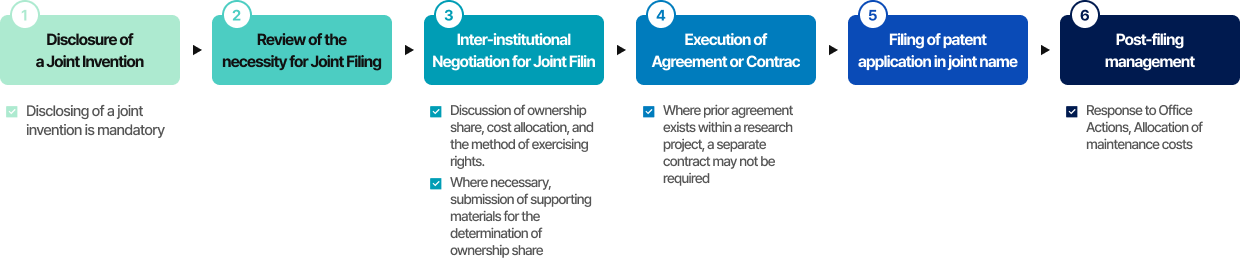
Procedure for Joint Filing
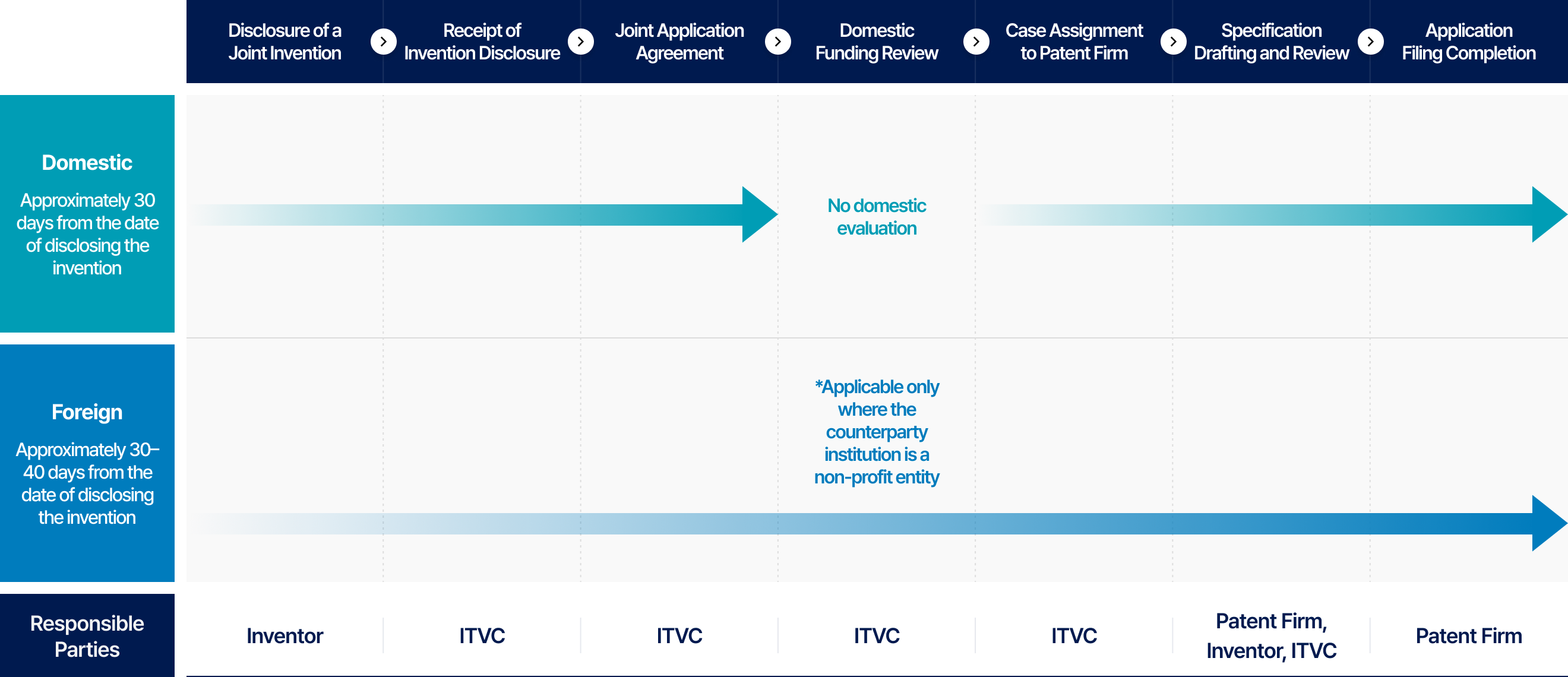
Cases Requiring Joint Filing

Joint Filing shall be required in the following cases:
  • Where KAIST researchers and external institutions (e.g., universities, companies, research institutes) jointly complete an invention
  • Where joint ownership of intellectual property (IP) is stipulated in a research agreement or project contract
  • Where inventorship contribution is clearly recognized across two or more institutions

Key Considerations for Joint Filing

01
Determination of Inventorship Contribution

The ownership share for Joint Filing shall be determined based on the inventorship contribution. The final ownership share shall be determined through prior inter-institutional negotiation.

02
Agreement on Cost Allocation for Filing and Maintenance

The allocation of filing and maintenance costs shall be determined through inter-institutional contracts or a separate agreement between the parties.

03
Agreement on Exercise of Rights (Licensing and Technology Transfer)

For jointly owned patents, prior inter-institutional negotiation shall be required regarding the scope of independent or joint practice, authority for Technology Transfer, and the method of revenue distribution.

04
Agreement on Domestic and Foreign Filing Strategy

The filing strategy shall be jointly determined through inter-institutional negotiation, including domestic priority claims and whether to file a PCT application.

Cost Allocation Guidelines for Joint Filing

In Joint-Applicant Filing, the allocation of costs shall be determined in accordance with the following principles, taking into account the nature of the counterparty institution and the ownership share.

Where the Counterparty is a Non-Profit Institution (e.g., Universities or Public Research Institutes)

Costs shall be allocated in proportion to the ownership share in the Joint Filing.
The ownership share, determined based on inventorship contribution, shall be applied as the basis for cost allocation.

Where the Counterparty is a For-Profit Entity (e.g., Companies)

As a general principle, the for-profit entity shall bear the costs.

RationaleJoint owners are entitled to practice the patent independently. Even where a for-profit entity practices the invention exclusively, there is no structural obligation to pay royalties to KAIST.
Accordingly, it is reasonable for the for-profit entity to bear the filing and issuance costs in lieu of paying consideration for practice.

Contact for Joint Filing

Where a Joint Filing is requested or inter-institutional negotiation is required, please contact:
Jaeyoon Kim, Intellectual Property and Technology Transfer Center

Frequently Asked Questions (FAQ)

Q1
Does joint research always require Joint Filing?
AWhere a KAIST member jointly makes an invention with an external institution, the inventor shall disclose the invention to KAIST as an Employee Invention. This is a mandatory procedure, regardless of the form of joint research, in order to evaluate the contribution of KAIST inventors and determine ownership of rights and conduct inter-institutional negotiation on ownership share.
Q2
Who determines the ownership share in Joint Filing?
AThe ownership share shall be determined based on the inventorship contribution of inventors from each institution and finalized through inter-institutional negotiation.
Q3
How is Technology Transfer handled after Joint Filing?
AIn general, the authority and the method of revenue distribution are determined in accordance with prior agreement between institutions or the Joint Filing agreement.
Q4
If the partner company has already prepared the patent application, is disclosure to KAIST still required?
A1In general, the authority and the method of revenue distribution are determined in accordance with prior agreement between institutions or the Joint Filing agreement.
A2Even where the preparation of the specification has already been carried out by the partner company or a Patent Firm, an Employee Invention of a KAIST inventor shall be disclosed through the Invention Disclosure process.
A3After disclosure: inventors of both KAIST and the partner institution shall complete Invention Disclosure procedures at their respective institutions; the necessity of Joint Filing, ownership share, and cost allocation shall be determined through inter-institutional negotiation and the patent application shall be filed jointly under both institutions upon agreement.

※ Note: Disclosing an Employee Invention is a mandatory procedure for inter-institutional negotiation and the clarification of ownership of rights. Accordingly, such disclosing shall not be omitted even where the partner institution has already completed preparation for filing.